

Team Integration

YOU CAN'T INDUCT SOMEONE INTO "BELONGING"
We’re very fond of induction processes, aren't we.
A welcome email. A handbook. A tour of the building. A few introductions. Perhaps a branded mug if you’re lucky!
Then, somewhere between day three and the end of week one, we quietly expect the new person to be “part of the team”.
But integrating new team members doesn’t really work like that.
Belonging takes longer. Trust takes longer.
Understanding where you fit, how people communicate, who needs what, where the invisible boundaries sit and how the whole thing works when nobody's looking takes longer still.
And sometimes, it simply takes as long as it takes.
What a New Horse Taught Me About Team Integration
I’ve recently welcomed another horse into my herd.
Magic is 24 years old and, rather unusually, she is Cloud’s mum.

Cloud is now 14 and they hadn’t seen one another since he was a weanling. I’ll admit that a small part of me wondered whether there might be some great cinematic reunion:
“Mum! Where have you been all my life?”
“My boy!”
There wasn’t... And actually, I was rather relieved!
I’d have hated to imagine them both spending the last 14 years pining for one another.
There was certainly some interest and recognition of sorts, but no dramatic reunion. Mostly, they behaved like horses meeting another horse... Which, of course, is exactly what was happening.
JOINING A TEAM ISN'T THE SAME AS "BELONGING"
Whenever I introduce a new horse, I don’t simply open the gate and hope everyone sorts themselves out.
Magic was initially kept separately, while still being able to see and communicate with the rest of the herd - It gives everyone time.
Time for the initial excitement to settle.
Time to watch.
Time to gather information.
Time for me to judge when it feels safe to allow them together.
In Magic’s case, that happened surprisingly quickly - after around 36 hours.
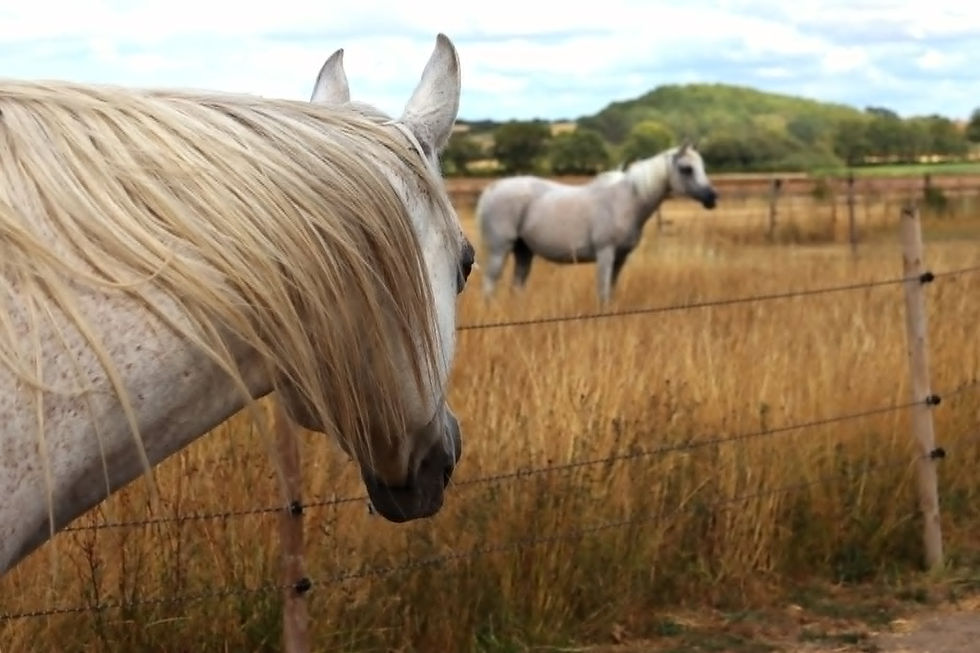
But opening the gate was only the beginning.
She is now part of the herd, but that doesn’t mean she is fully integrated. She is quietly accepted, provided she remains around the edges.
Gradually, those edges are getting closer. The distance is reducing.
Relationships are being negotiated. The herd is adjusting... And so is she.
Nobody handed her an induction pack explaining where she should stand, who gets first access to the hay or how close she may come before somebody asks her to move. She has to learn those things through relationship.
Humans may have slightly more sophisticated onboarding systems, but I’m not convinced we’re always much better at the relationship bit.
Employee Onboarding Is Not the Same as Integration
Organisations can be very good at getting someone operational:
Do they have their laptop?
Can they access the systems?
Have they completed the mandatory training?
Do they know where the toilets are?
All useful, but none of it tells us whether they feel part of the team.
Real team integration happens in dozens of small interactions.
It happens when someone feels safe enough to ask the question they think they should already know the answer to.
When they begin to understand the humour in the room.
When they discover whose silence means “I’m thinking” and whose silence means “something is wrong”.
When colleagues stop behaving slightly differently because the new person is there.
When disagreement becomes possible without threatening the relationship.
When the newcomer no longer feels they are permanently standing on the edge of the group waiting to be invited closer.
You cannot timetable that into a two-week induction programme.
BUILDING EFFECTIVE TEAMS MEANS LOOKING BEYOND SKILLS...
And, for me, that's where it's too easy to get the priorities the wrong way round.
It’s also another reason I find herd integration so interesting.
A group is changed by every individual who joins it. You are never simply adding one more member while everything else remains the same.
Relationships shift.
Roles alter.
Existing dynamics become more visible.
Sometimes new alliances form.
Sometimes an apparently settled team suddenly reveals tensions that were already there.
That matters enormously when we recruit people.
We understandably look at skills, qualifications and experience:
Can this person do the job?
But perhaps we should spend at least as much time asking:
How does this person behave when things don’t go their way?
How curious are they about other people?
Can they disagree without needing to win?
What happens when they make a mistake?
Can they take responsibility?
How do they affect the people around them?
Do their values and behaviour strengthen what we are trying to build here?
Because skills can often be taught, developed or supplemented, but behaviour that repeatedly damages trust is rather harder to accommodate.
One technically brilliant person who leaves everyone else walking on eggshells can cost an organisation far more than the gap they were recruited to fill!
Team Dynamics Change When Someone New Arrives
There's another uncomfortable truth about welcoming somebody new: Integration is not solely the newcomer’s responsibility!
Magic isn’t the only member of my herd having to adjust. Every horse is... And not necessarily in the way I expected.
Cloud, despite being her son, has actually been one of the horses most inclined to keep her at a distance - moving her on and controlling her access to space, food or water.
I can construct all sorts of human explanations for that behaviour, but they would be exactly that - human explanations.
What I can observe is that her arrival has changed something - Cloud is behaving differently simply because Magic is there.
That feels particularly relevant to human teams.
When someone joins, we tend to concentrate on how well they are “fitting in”.
Perhaps we should also pay closer attention to what their arrival reveals about everybody else.
Who welcomes them?
Who feels threatened?
Who becomes protective of territory?
Who steps forward?
Who withdraws?
Who suddenly behaves in a way we haven’t noticed before?
A new team member doesn’t just need to learn the team. The team needs to learn itself again.
GOOD TEAM INTEGRATION TAKES TIME
Good integration isn’t about leaving people to sink or swim.
Nor is it about forcing instant togetherness through away-days, icebreakers and enthusiastic declarations that “we’re like a family here”.
It is about creating enough safety, space and attention for real relationships to develop.
Check in after the first week... But also after the first month... And the third.
Notice what is changing.
Ask what feels easier.
Ask what still feels awkward.
Pay attention to the existing team as well as the newcomer.
And resist the temptation to decide too quickly whether somebody has “settled in”.

Magic has joined my herd.
She has not yet fully found her place within it.
Those are two different things.
And perhaps that's worth remembering the next time somebody new arrives at work:
You can complete an induction in a week... You can’t put a deadline on "belonging."
As always, you know where to find me if you want to chat about how your team can "learn itself" again.


Comments